Besides being a day for Albanian nationalism, the country’s independency day is besides coincidentally the birthday of Adem Jashari, the erstwhile leader of the Kosovo Liberation Army or KLA (UÇK in Albanian). Killed by Serbian forces in 1998, he has since been lionized as the most crucial martyr in the pantheon of modern Kosovo’s national heroes. Having gathered a group of die-hard militants around him willing to fight against the repressive Serbian government’s control over the area, Jashari helped transform a years-long run of persistent, yet ineffective civilian disobedience against Serbian president Slobodan Milošević into a full-on armed insurgency.
Kosovo suffered from a devastating war from 1998 to 1999, just 1 part of the larger series of Yugoslav Wars. The effects of the conflict can inactive very much be felt today. It is not different to see televisions in cafés set to music channels with marathons of patriotic pop songs, with handsome singers in KLA uniforms belting out catchy melodies while gesturing over the dramatic landscapes that are ubiquitous across the Kosovar countryside.
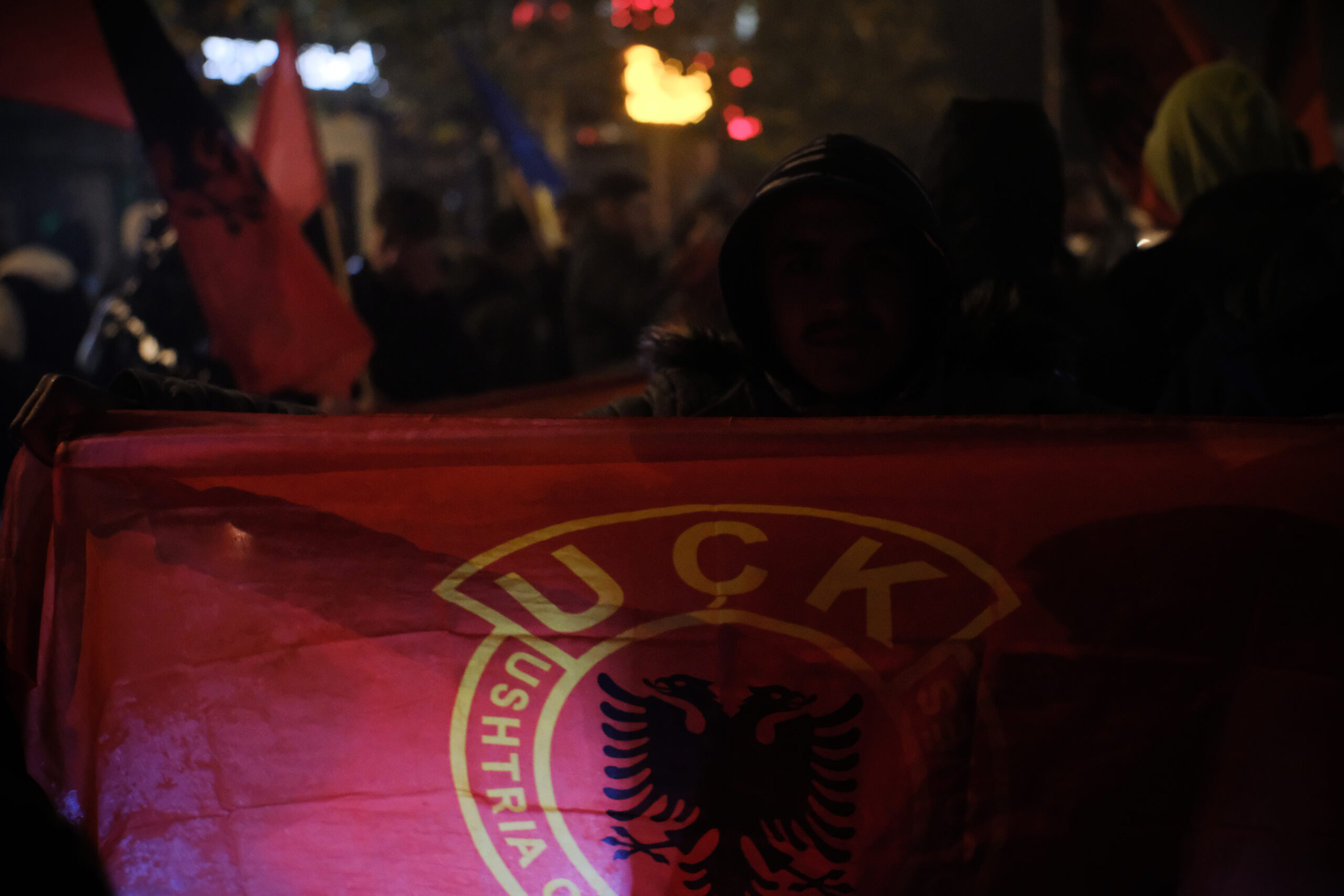
Supporter of the KLA (Kosovo Liberation Army, or UÇK in Albanian) poses for a photograph with their flag. Prizren, Kosovo.
In Prizren, the streets were flooded with mostly teenagers on November 28th. They enthusiastically waved Albanian, Kosovar and KLA flags and shot off fireworks, all the while 3 or 4 visibly annoyed Kosovo Police officers failed to keep them out of the street. A caravan of cars honked and filled the air with smoke from doing burnouts. Kosovo is the youngest country in Europe, with around half of the population believed to be under the age of 30, and it is moments like these that you truly announcement it.
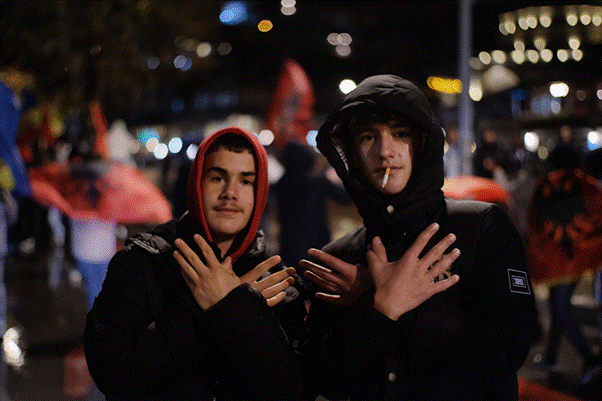
Teenagers celebrate Albanian independency Day. Prizren, Kosovo.
“I think that Albania and Kosovo are one. All my household thinks the same way. There’s no request to be apart erstwhile we can be 1 and powerful,” said Florjian, a 15-year-old associate in the flag-waving revelry. He is referencing the political thought of Greater Albania, in which Albania and Kosovo would be united as 1 country. His friend agreed and I took their photograph as they made the eagle motion with their hands, a common patriotic expression symbolizing the double-headed eagle on the Albanian flag.
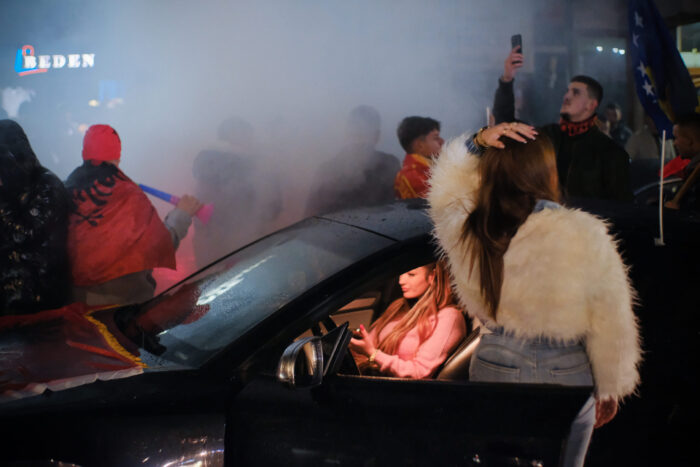
Young people out revelling in Prizren during the independency day.
Past and present
Prizren is considered the cultural capital of Kosovo, yet it is besides considered 1 of the most crucial seats of the Serbian Orthodox Church, with respective medieval Orthodox churches of note. 1 specified church, the 14th century Our woman of Ljeviš, has been closed to visitors after falling into disrepair. This happened after the 2004 unrest (what Serbs call the “March Pogrom”) in which Albanians across Kosovo desecrated Orthodox churches and killed at least 14 Serbs, 1 of the first incidents after the war that indicated that the conflict may not have been as dormant as it had seemed to any in the West.
Another church on a hillside overlooking Prizren, said to have been built around 1330, was half destroyed and now sits vacant, inaccessible to visitors. It is estimated that over 900 Serbian churches were damaged or totally destroyed, and around 4,000 Serb, Roma and Ashkali civilians were expelled from towns, villages and even the capital Pristina during the 2004 unrest. These post-war reprisals are ugly but it is simply a fact that far more Albanians were expelled from their homes during the war. They were either internally displaced or forced into exile camps in the frigid mountain areas over the border in Montenegro and North Macedonia. Despite this, most of them yet returned. It is besides actual that far more Albanian civilians were killed than Serbian civilians throughout the conflict.
In consequence to respective years of conflict by Kosovar Albanians against the Yugoslav authorities, Milošević cracked down on dissent by suspending the autonomous position that Kosovo had long enjoyed under the government of Josip Broz Tito. Despite his authoritarian tendencies, the celebrated leader did manage to keep the peaceful coexistence of the different cultural groups in Yugoslavia. After Tito’s death, however, cultural rivalries rapidly rose to the surface again. alternatively than assuaging these conflicts and following Tito’s strategy, Milošević looked to exploit them to solidify his power, a grave mistake that led to war.
Years of conflict between the Serbian authorities and the KLA yet culminated in the Kosovo War, with the NATO bombing of Serbian positions marking a major turning point. cultural Albanians shortly after managed to gain full control of Kosovo. After the debacle in Bosnia, Bill Clinton and his NATO allies were keen on rapidly putting an end to what looked like another nasty cycle of reprisals that would yet put civilians in the crosshairs.
Kosovo unilaterally declared independency in 2008, a decision that angered the cultural Serb minority, which is mostly concentrated in north Kosovo and in tiny enclaves close the fewer remaining Serbian Orthodox churches and monasteries. Most of them do not admit Kosovo as an independent country and proceed to view it as a part of Serbia.
“The alleged KLA, immediately after it was founded, was declared a terrorist organization by the American administration,” said Dejan Baljosevic, vice president of the Serbian National Council of Kosovo and Metohija.
“Later, the West realized that the fighters of the alleged KLA could service them as an advanced infantry that could prepare the way for NATO to march on the territory of orthodox Serbia, which they saw as an enemy to their interests in their crusade to the East and expansion towards the borders of Russia.”
His comments might seem extremist to Western Europeans, but they are considered mainstream in the Kosovar Serb community. Dejan and his wife are members of the Kosovar Serb number that live in the Serb part of Orahovac, an isolated community in western Kosovo.
“The many Albanian flags and monuments erected in tribute to the fallen fighters of the alleged KLA next to the main roads are a way to mark the conquered territories. But they besides show that despite tremendous support from the West, Albanians are not certain of their independence. erstwhile they cannot legally accomplish their independency in the most crucial global organizations, then they effort to at least visually show that Kosovo now belongs to them,” he added.
Tensions have risen substantially in the past fewer years after disagreements over Serbian licence plates sparked anger. A heavily-armed group of Serbian militiamen then engaged in a weapon conflict with Kosovo Police in the northern town of Banjska, where they barricaded themselves in a close monastery. 4 were killed in the assault and the Kosovo authorities implicated Serbia’s leaders, pointing to the extended arsenal seized from the group as proof of state backing. The self-admitted leader of the attack was Milan Radoičić, an influential Kosovar Serb politician with ties to the authorities in Belgrade. Serbian president Aleksandar Vučić refused to extradite Radoičić to Pristina, saying “he was my close ally.”
Uncertain justice
On November 28th, Vjosa Osmani, the current president of Kosovo, was at the Jashari household memorial site in the hero’s ancestral village of Prekaz to give a televised speech. The tiny village features small more than the perfectly preserved, bullet-hole ridden buildings of the Jashari household compound, a comparatively fresh museum building, gift shops full of red and black Albanian souvenirs, and a sprawling monument with the tombs of the more than 50 members of the Jashari household – women and children included – killed by a peculiar Serbian police unit in 1998.
It was a massacre that shocked Albanians and Kosovar Albanians alike, leading to a immense uptick in recruitment to the KLA, as well as large amounts of backing and arms from the diaspora. It marked a turning point erstwhile western governments began to question Serbia and military options were put on the table. The US and NATO gave material and tactical support to the KLA, with insiders and diplomats joking at the time that NATO was the KLA’s air force. The CIA besides funded and trained them.
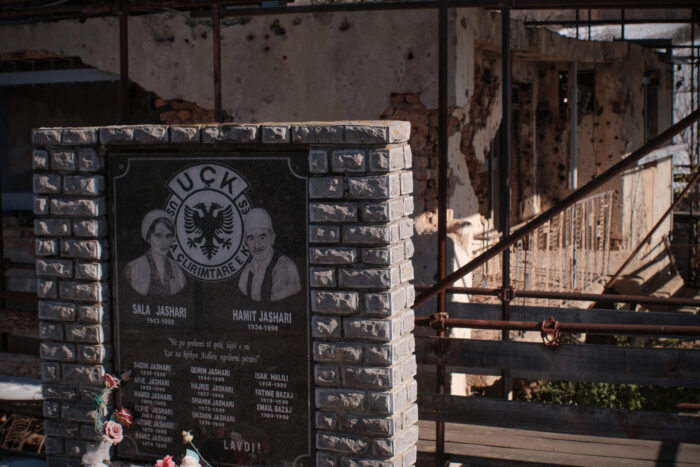
A memorial tombstone for household members of Adem Jashari killed in the Serbian forces’ raid, with the destroyed home in the background.
Though not officially a public vacation in Kosovo, Osmani paid tribute to Adem Jashari and the KLA on this anniversary of his birthday. Meanwhile, Osmani’s predecessor Hashim Thaçi, a erstwhile top-level leader in the KLA who later became president of Kosovo, faces a trial for war crimes in a peculiar court in The Hague. His case is being weighed by the by the Kosovo Specialist Chambers and Specialist Prosecutor’s Office, which was established under an global agreement between Kosovo and the European Union. People in Kosovo have not been shy about expressing their opposition to the process and displays of Thaçi’s image are not uncommon in Kosovo’s cities and towns.
There are presently 10 another erstwhile KLA members detained in The Hague who are besides facing charges. They have all pleaded not guilty to their charges. 3 erstwhile KLA leaders were successfully convicted of war crimes by the prosecutors, including erstwhile Commander Salih Mustafa, who was sentenced to 26 years for torture, arbitrary detention and murder. In general, the proceedings have been marred by witness tampering and charges of contempt of court. 2 others were sentenced to 4 years in prison and fined for witness intimidation, what Presiding justice Charles Smith called creating an environment of fear in which giving evidence was seen as “criminal and unpatriotic”.
It was in 2020 that the Kosovo Specialist Chambers filed a ten-count indictment that charged Hashim Thaçi and another KLA leaders with war crimes, including torture, forced disappearances and nearly 100 murders.
“They are charged by the prosecution with crimes as individuals. It’s not any organization – for example the KLA – or any cultural group that’s on trial, but alternatively individuals,” said Kosovo Specialist Chambers Spokesperson Michael Doyle.
“The judges who are tasked with the different cases are operating irrespective of any political developments [in Kosovo]. They’re applying the law and the rules in order to guarantee that there are fair, independent, and safe proceedings in line with global justice standards.”
An unclear future
The trial of erstwhile president Thaçi is considered the most crucial case presently playing out in relation to erstwhile KLA leaders and their alleged crimes. The moves to hinder its advancement behind closed doors are indicative of a desire among Kosovo authorities to proceed evading responsibility. The level of public support for the KLA in Kosovo, especially among young people, is another worrying sign that actual reconciliation may inactive be rather far off. And if justice for victims on both sides of the war is not decently pursued, the stalemate between Serbia and Kosovo may never be full resolved. If it is never resolved, Kosovo will never be able to attain its goal of full designation and yet accession to the EU.
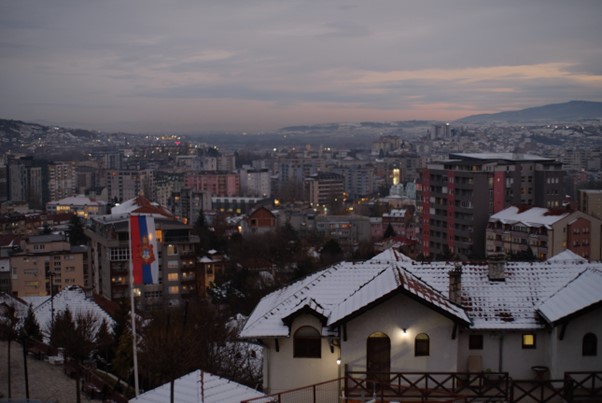
Cityscape of Mitrovica, the largest city in north Kosovo. A Serbian flag is visible over the Serbian side of the city, with the confederate Albanian side seen in the far background, across the Ibar River.
Nowhere is the tension between Albanians and Serbs more apparent than in the city of Mitrovica. The city is divided by the Ibar river, with Albanians surviving in the south and Serbs in the north. 1 resident of the confederate side of Mitrovica told me he utilized to live in the northern side. However, he was made to leave his home after Serbs forced him out in 2000, just after the war ended. He claims that a Serbian household has been squatting in his flat always since and he has been powerless to do anything about it. Conversely, Serbs were besides expelled from the south side of the city.
Organized crime on both sides has flourished in Mitrovica, with criminal groups taking advantage of the legal grey areas in enforcement and jurisdiction in this city in limbo. In fact, I was told by 1 resident that organized crime leaders on both sides of Mitrovica work together alternatively efficiently in smuggling operations, despite a language barrier – and the fact that they ostensibly hatred each other.
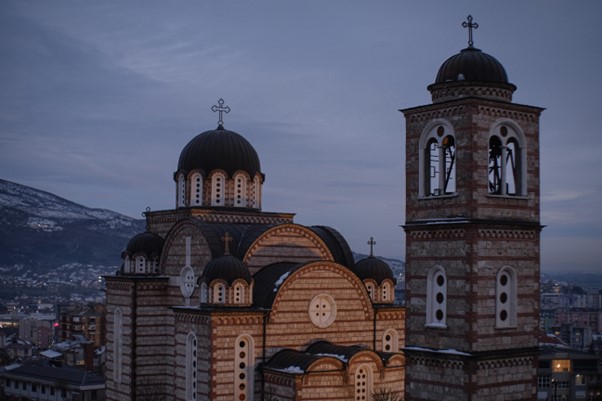
Serbian Orthodox Church on the Serbian side of Mitrovica.
I struck up conversation with a group of 3 young men at Skopje global Airport in the line in front of me after it became clear that they were American military personnel. They said they were stationed in Kosovo as part of the UN-led KFOR global peacekeeping force.
One of them told me that despite the fresh emergence in tensions, they did not have the sense that things were headed for an escalation. He mentioned looming deadlines for Kosovo licence plates and ID cards, which Serbians are being forced to accept, as a possible point that could worsen tensions. He said he doubted that there would be a return to any serious conflict. However, the very presence of global peacekeepers 20 years after the war, the fresh weapon conflict in Banjska, and the general atmosphere of utmost nationalism (on both sides) are all signs that his opinion may possibly be overly optimistic.
All photos by Kian Seara Rey
Kian Seara Rey is simply a Spanish-American writer and photographer based in the Netherlands.
Please support New east Europe's crowdfunding campaign. Donate by clicking on the button below.